
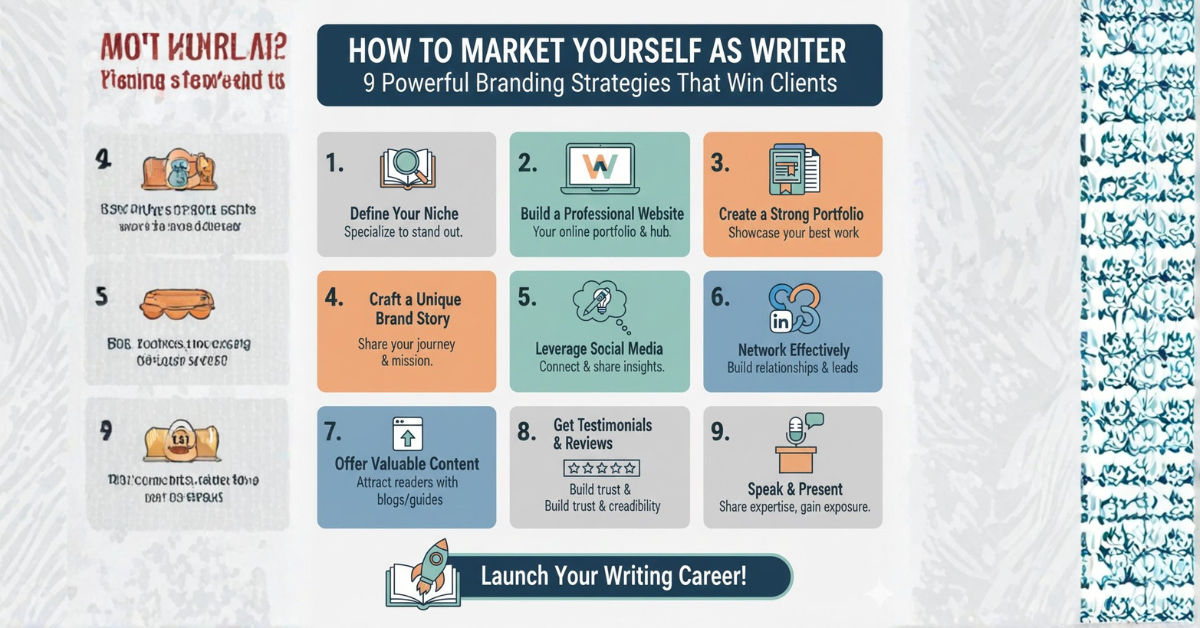
How to Market Yourself as a Writer: 9 Powerful Branding Strategies That Win Clients
If you’re searching how to market yourself as a writer, you’re probably dealing with one of these situations:
- You can write, but you don’t know how to get noticed.
- You’ve posted online, but it’s not translating into real opportunities.
- You’re applying for gigs, pitching clients, or building an author presence, and it feels scattered.
The good news is that marketing yourself as a writer doesn’t have to be loud or complicated. It’s mostly about clarity and consistency: knowing what you do, who it’s for, and how to make it easy for people to hire you or follow your work.
This guide is written for the market and covers both sides of “writer marketing”:
- authors building an audience and platform
- freelancers and content writers looking for clients
You’ll learn a simple writer marketing strategy, how to build writer personal branding, what to include in a writer portfolio website, and how to turn your content into conversions. And yes—this will stay friendly and practical, not robotic.
Step 1: Get clear on your writer brand identity

Most writers struggle with marketing because they start with tactics (“post more,” “cold pitch,” “make a website”) before they clarify positioning.
Start with three answers:
1) What kind of writer are you?
Examples:
- freelance content writer
- copywriter (sales pages, ads, email sequences)
- ghostwriter
- author (fiction/nonfiction)
- technical writer
- grant writer
2) Who do you help?
This is your target audience / ideal client profile.
Examples:
- small businesses in the U.S. needing blog content
- SaaS companies needing email sequences
- coaches who need a book ghostwriter
- romance readers who love small-town series
3) What outcome do you create?
Outcomes sell.
Examples:
- “I write blog posts that rank and convert.”
- “I write web copy that increases leads.”
- “I help authors turn rough drafts into publish-ready books.”
That’s writer personal branding in plain English: clarity that makes you easy to hire and easy to remember.
Step 2: Build a simple marketing plan for writers
A marketing plan for writers doesn’t need to be 20 pages. It needs to answer:
- Where will people discover you?
- What will they see first?
- How will they trust you?
- How will they contact you?
Here’s a simple 4-part writer marketing system:
- Visibility (content or outreach)
- Credibility (samples, proof, clear positioning)
- Conversion (a clear offer + CTA)
- Consistency (repeat weekly)
If you can maintain this weekly, your marketing stops feeling like guesswork.
Step 3: Create a writer portfolio website
You can market yourself without a website, but having a simple writer portfolio website makes everything easier:
- clients can understand you quickly
- you look more professional
- your work is organized
- you control your brand messaging
What to include (minimum)
- Homepage: who you help + what you write + the outcome you deliver
- Portfolio / samples: 6–12 strong samples (quality over quantity)
- Services: packages or clear deliverables
- About: a short, credible writer bio
- Contact: easy form or email + response expectation
Keep it skimmable. Most U.S. clients spend seconds deciding whether to explore further.
If you don’t have samples yet
Write 3–5 “spec” pieces:
- a blog post in your target niche
- a landing page rewrite (before/after)
- an email sequence sample
- a case-study style piece showing your thinking
Spec samples are not fake—they’re demonstrations. They help you get your first “yes.”
Step 4: Build credibility fast (without bragging)
Credibility signals matter in marketing for writers. In the U.S., people look for proof before they pay.
Strong credibility signals include:
- testimonials (even from small projects)
- clear writing samples
- niche consistency
- case studies (“here’s the problem, here’s what I wrote, here’s the result”)
- a professional bio and headshot
A simple author bio / writer bio format:
- who you are + what you write
- who you write for
- 1–2 credibility points (years, industries, outcomes)
- a human line (why you care, what you’re known for)
Keep it confident and clean—no fluff.
Step 5: Content marketing for writers (the easiest long-term strategy)
Content marketing for writers works because it builds trust before the sales conversation starts. The goal is not to “go viral.” The goal is to become consistently visible to the right people.
Choose 3 content pillars
Pick three topic buckets you can talk about weekly, like:
- writing tips + clarity improvements
- your niche (e.g., dental, legal, SaaS, education)
- behind-the-scenes process (how you work, your frameworks)
Then post consistently using a simple rhythm:
- one helpful tip post
- one example/case-study post
- one personal/process post
This builds thought leadership without needing dramatic content.
Step 6: Social media marketing for writers
You don’t need to be everywhere. Choose one place where your audience already pays attention and commit to it.
For many writers, LinkedIn for writers is especially effective in the U.S. because:
- clients and hiring managers are already there
- professional content is expected
- one good post can bring inbound leads
A simple LinkedIn-style posting strategy (weekly)
- 1 post: “Here’s a writing mistake that loses conversions”
- 1 post: “Before/after rewrite” (short example)
- 1 post: “Mini case study” (what you wrote + why it worked)
Always add a soft CTA:
- “If you want help rewriting your homepage, message me.”
- “If you need consistent blog content, I can help.”
That’s how social media marketing for writers becomes conversion-friendly instead of “posting for likes.”
Step 7: How to get writing clients
If you’re wondering how to get writing clients, use a two-lane approach:
Lane A: Inbound (content)
- your posts + portfolio bring people to you
- slower at first, but compounding
Lane B: Outbound (outreach)
- pitching, networking, referrals
- faster results when done consistently
A simple outreach routine:
- pick 10 potential clients each week
- send short, polite messages with a clear offer
- include one relevant sample
- make the next step easy (“Want me to suggest 3 headline options?”)
Keep the message about them and their outcome, not your biography.
Step 8: Offer packages
Many writers lose clients because they only say “I charge per word.” Most U.S. clients prefer clear packages.
Examples of service packages:
- 4 blog posts per month + updates
- website copy refresh (homepage + about + services page)
- email sequence package (welcome series or launch sequence)
- content strategy + writing bundle
Packages reduce decision fatigue and increase conversion.
Step 9: Keep your brand voice consistent
Your writer brand identity isn’t just your niche—it’s your voice. Brand voice is:
- how you explain things
- your tone (friendly, direct, insightful)
- your style (simple, structured, story-driven)
Consistency builds familiarity, and familiarity builds trust.
Conclusion
Learning how to market yourself as a writer isn’t about becoming a different person. It’s about becoming easier to understand. When you clarify your niche, build a simple portfolio, show your thinking through content, and create clear offers, your marketing stops feeling random—and starts producing opportunities.
If you want support building your writer brand, tightening your portfolio messaging, or creating a practical writer marketing strategy, US Writers can help you turn your writing skill into consistent visibility and real client conversations.
FAQs: How to market yourself as a writer
1) How do I start if I’m new and don’t know how to market myself as a writer?
Start with clarity: pick a writing type (content, copy, ghostwriting, author work) and one audience. Build 3–5 spec samples, create a simple portfolio page, and post weekly content that shows your thinking. Consistency matters more than perfection.
2) What is writer personal branding, and why does it matter?
Writer personal branding is how you position yourself so people understand what you do, who you help, and why you’re a good choice. It matters because it reduces confusion and increases trust—especially when clients compare multiple writers.
3) Do I need a niche to promote myself as a writer?
A niche helps you stand out and get hired faster. You can start broad, but narrowing to one or two industries or content types usually improves your results and makes your portfolio more believable.
4) What should I include in a writer portfolio website?
Include a clear headline (who you help + outcome), a portfolio section with strong samples, your services and packages, a short writer bio, and an easy contact method. Keep it simple and skimmable.
5) How do I promote myself as a writer on LinkedIn effectively?
Post consistently, share examples of your work (mini case studies, before/after rewrites), and use a clear CTA. Comment thoughtfully on posts from your target audience. It’s not about volume—it’s about relevance and consistency.If you’re searching how to market yourself as a writer, you’re probably dealing with one of these situations:
- You can write, but you don’t know how to get noticed.
- You’ve posted online, but it’s not translating into real opportunities.
- You’re applying for gigs, pitching clients, or building an author presence, and it feels scattered.
The good news is that marketing yourself as a writer doesn’t have to be loud or complicated. It’s mostly about clarity and consistency: knowing what you do, who it’s for, and how to make it easy for people to hire you or follow your work.
This guide is written for the market and covers both sides of “writer marketing”:
- authors building an audience and platform
- freelancers and content writers looking for clients
You’ll learn a simple writer marketing strategy, how to build writer personal branding, what to include in a writer portfolio website, and how to turn your content into conversions. And yes—this will stay friendly and practical, not robotic.
Step 1: Get clear on your writer brand identity
Most writers struggle with marketing because they start with tactics (“post more,” “cold pitch,” “make a website”) before they clarify positioning.
Start with three answers:
1) What kind of writer are you?
Examples:
- freelance content writer
- copywriter (sales pages, ads, email sequences)
- ghostwriter
- author (fiction/nonfiction)
- technical writer
- grant writer
2) Who do you help?
This is your target audience / ideal client profile.
Examples:
- small businesses in the U.S. needing blog content
- SaaS companies needing email sequences
- coaches who need a book ghostwriter
- romance readers who love small-town series
3) What outcome do you create?
Outcomes sell.
Examples:
- “I write blog posts that rank and convert.”
- “I write web copy that increases leads.”
- “I help authors turn rough drafts into publish-ready books.”
That’s writer personal branding in plain English: clarity that makes you easy to hire and easy to remember.
Step 2: Build a simple marketing plan for writers
A marketing plan for writers doesn’t need to be 20 pages. It needs to answer:
- Where will people discover you?
- What will they see first?
- How will they trust you?
- How will they contact you?
Here’s a simple 4-part writer marketing system:
- Visibility (content or outreach)
- Credibility (samples, proof, clear positioning)
- Conversion (a clear offer + CTA)
- Consistency (repeat weekly)
If you can maintain this weekly, your marketing stops feeling like guesswork.
Step 3: Create a writer portfolio website
You can market yourself without a website, but having a simple writer portfolio website makes everything easier:
- clients can understand you quickly
- you look more professional
- your work is organized
- you control your brand messaging
What to include (minimum)
- Homepage: who you help + what you write + the outcome you deliver
- Portfolio / samples: 6–12 strong samples (quality over quantity)
- Services: packages or clear deliverables
- About: a short, credible writer bio
- Contact: easy form or email + response expectation
Keep it skimmable. Most U.S. clients spend seconds deciding whether to explore further.
If you don’t have samples yet
Write 3–5 “spec” pieces:
- a blog post in your target niche
- a landing page rewrite (before/after)
- an email sequence sample
- a case-study style piece showing your thinking
Spec samples are not fake—they’re demonstrations. They help you get your first “yes.”
Step 4: Build credibility fast (without bragging)
Credibility signals matter in marketing for writers. In the U.S., people look for proof before they pay.
Strong credibility signals include:
- testimonials (even from small projects)
- clear writing samples
- niche consistency
- case studies (“here’s the problem, here’s what I wrote, here’s the result”)
- a professional bio and headshot
A simple author bio / writer bio format:
- who you are + what you write
- who you write for
- 1–2 credibility points (years, industries, outcomes)
- a human line (why you care, what you’re known for)
Keep it confident and clean—no fluff.
Step 5: Content marketing for writers (the easiest long-term strategy)
Content marketing for writers works because it builds trust before the sales conversation starts. The goal is not to “go viral.” The goal is to become consistently visible to the right people.
Choose 3 content pillars
Pick three topic buckets you can talk about weekly, like:
- writing tips + clarity improvements
- your niche (e.g., dental, legal, SaaS, education)
- behind-the-scenes process (how you work, your frameworks)
Then post consistently using a simple rhythm:
- one helpful tip post
- one example/case-study post
- one personal/process post
This builds thought leadership without needing dramatic content.
Step 6: Social media marketing for writers
You don’t need to be everywhere. Choose one place where your audience already pays attention and commit to it.
For many writers, LinkedIn for writers is especially effective in the U.S. because:
- clients and hiring managers are already there
- professional content is expected
- one good post can bring inbound leads
A simple LinkedIn-style posting strategy (weekly)
- 1 post: “Here’s a writing mistake that loses conversions”
- 1 post: “Before/after rewrite” (short example)
- 1 post: “Mini case study” (what you wrote + why it worked)
Always add a soft CTA:
- “If you want help rewriting your homepage, message me.”
- “If you need consistent blog content, I can help.”
That’s how social media marketing for writers becomes conversion-friendly instead of “posting for likes.”
Step 7: How to get writing clients
If you’re wondering how to get writing clients, use a two-lane approach:
Lane A: Inbound (content)
- your posts + portfolio bring people to you
- slower at first, but compounding
Lane B: Outbound (outreach)
- pitching, networking, referrals
- faster results when done consistently
A simple outreach routine:
- pick 10 potential clients each week
- send short, polite messages with a clear offer
- include one relevant sample
- make the next step easy (“Want me to suggest 3 headline options?”)
Keep the message about them and their outcome, not your biography.
Step 8: Offer packages
Many writers lose clients because they only say “I charge per word.” Most U.S. clients prefer clear packages.
Examples of service packages:
- 4 blog posts per month + updates
- website copy refresh (homepage + about + services page)
- email sequence package (welcome series or launch sequence)
- content strategy + writing bundle
Packages reduce decision fatigue and increase conversion.
Step 9: Keep your brand voice consistent
Your writer brand identity isn’t just your niche—it’s your voice. Brand voice is:
- how you explain things
- your tone (friendly, direct, insightful)
- your style (simple, structured, story-driven)
Consistency builds familiarity, and familiarity builds trust.
Conclusion
Learning how to market yourself as a writer isn’t about becoming a different person. It’s about becoming easier to understand. When you clarify your niche, build a simple portfolio, show your thinking through content, and create clear offers, your marketing stops feeling random—and starts producing opportunities.
If you want support building your writer brand, tightening your portfolio messaging, or creating a practical writer marketing strategy, US Writers can help you turn your writing skill into consistent visibility and real client conversations.
FAQs: How to market yourself as a writer
1) How do I start if I’m new and don’t know how to market myself as a writer?
Start with clarity: pick a writing type (content, copy, ghostwriting, author work) and one audience. Build 3–5 spec samples, create a simple portfolio page, and post weekly content that shows your thinking. Consistency matters more than perfection.
2) What is writer personal branding, and why does it matter?
Writer personal branding is how you position yourself so people understand what you do, who you help, and why you’re a good choice. It matters because it reduces confusion and increases trust—especially when clients compare multiple writers.
3) Do I need a niche to promote myself as a writer?
A niche helps you stand out and get hired faster. You can start broad, but narrowing to one or two industries or content types usually improves your results and makes your portfolio more believable.
4) What should I include in a writer portfolio website?
Include a clear headline (who you help + outcome), a portfolio section with strong samples, your services and packages, a short writer bio, and an easy contact method. Keep it simple and skimmable.
5) How do I promote myself as a writer on LinkedIn effectively?
Post consistently, share examples of your work (mini case studies, before/after rewrites), and use a clear CTA. Comment thoughtfully on posts from your target audience. It’s not about volume—it’s about relevance and consistency.