
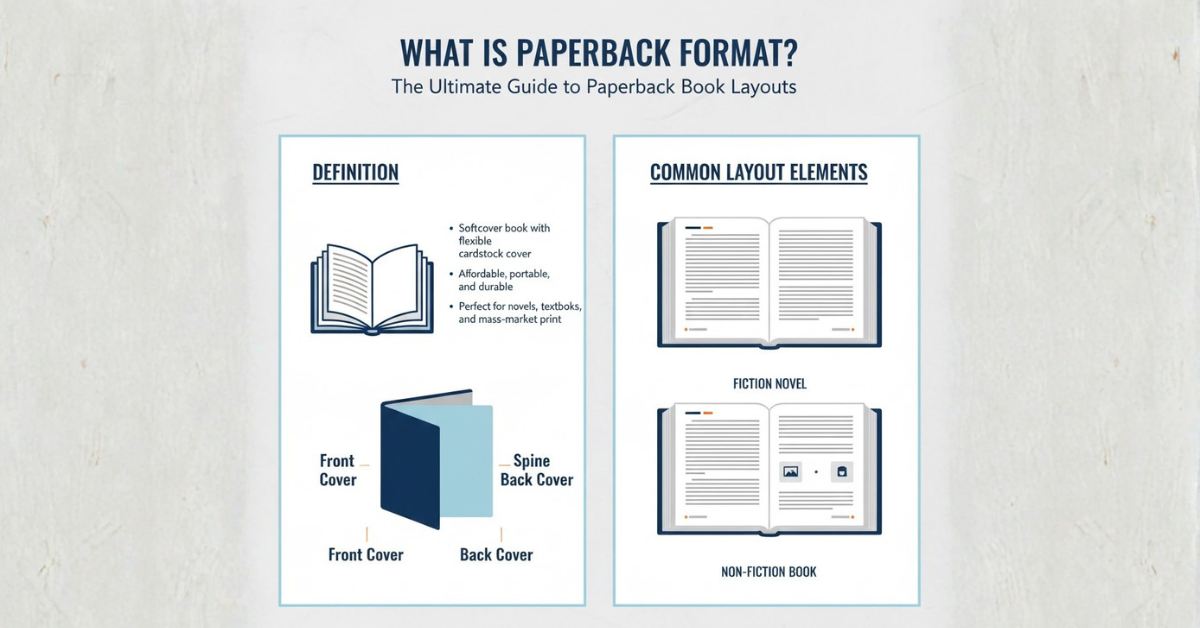
What Is Paperback Format? The Ultimate Guide to Paperback Book Layouts
If you’re publishing a book (or even just shopping for one), you’ve probably seen the word “paperback” everywhere. But if you’re new to publishing, it’s normal to wonder what is paperback format exactly—and why there are different kinds of paperbacks, different sizes, and different printing options.
This guide explains the paperback format meaning in plain language for authors and readers. You’ll learn the difference between paperback vs hardcover, what “trade paperback” and “mass market paperback” mean, how paperback formatting works, what a paperback trim size is, and what to check before printing. The goal is simple: you should finish this article feeling confident about choosing the right paperback book format for your project.
What is paperback format (in publishing)?
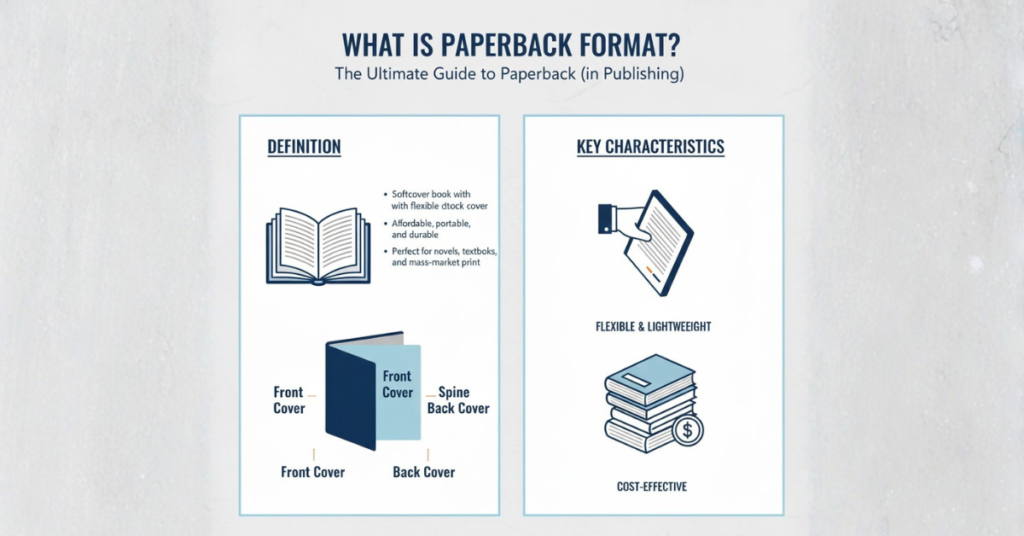
What is paperback format? In publishing, a paperback is a physical book with a flexible paper-based cover (not a rigid hard case). Paperbacks are typically lighter, cheaper to produce, and easier to carry than hardcovers.
When people say “paperback,” they usually mean:
- a soft cover (often laminated for durability)
- pages bound together with glue (commonly perfect binding)
- a standard book size (also called trim size) such as 5″ x 8″ or 6″ x 9″ in the U.S.
So the paperback format meaning comes down to the book’s physical build: soft cover + bound pages + a cost-effective print method.
Paperback vs hardcover (what’s the real difference?)
When comparing paperback vs hardcover, think of three big differences: durability, price, and presentation.
A hardcover:
- has a rigid cover and often a dust jacket
- feels premium and gift-ready
- costs more to print and usually sells at a higher price
A paperback:
- has a flexible cover
- is more affordable for readers
- is a common choice for first-time authors and self-publishers because the print cost is typically lower
In the U.S. market, hardcovers can be powerful for launches and collectors, while paperbacks tend to be the everyday bestseller format because they’re accessible and easy to buy.
Trade paperback format vs mass market paperback format
Not all paperbacks are the same. The two most common types are:
Trade paperback format
A trade paperback format is the more “modern standard” paperback you’ll see in bookstores and online. It’s usually larger (often 5″ x 8″ or 6″ x 9″), with better paper and a higher-quality feel. Many fiction and nonfiction books use trade paperback.
Trade paperback is common for:
- novels and memoirs
- business and self-help books
- educational and professional guides
Mass market paperback format
A mass market paperback format is smaller and more compact, traditionally designed for high-volume, lower-price distribution (think older pocket-sized books). It’s often found in airports, grocery stores, and traditional mass distribution channels.
Mass market is associated with:
- compact size
- lower retail price
- thinner paper and tighter margins
If you’re self-publishing, trade paperback is usually the easier default because it fits modern expectations and common POD workflows. Mass market can still work, but it’s more specific and not always the best starting format for a new author.
Paperback book size and trim size (what those terms mean)
A paperback book size is typically referred to as its paperback trim size. Trim size is simply the width and height of the finished book after printing and trimming.
Common U.S. trim sizes include:
- 5″ x 8″ (popular for novels)
- 5.5″ x 8.5″ (a comfortable fiction size)
- 6″ x 9″ (common for nonfiction, business, and many novels)
- 8.5″ x 11″ (common for workbooks, manuals, textbooks)
Choosing trim size is not just a “design preference.” It affects:
- readability (line length and spacing)
- page count (and printing cost)
- spine width (which affects the cover layout)
- how the book “feels” in a reader’s hands
A practical rule:
If you want your paperback to look like a familiar U.S. bookstore book, trade sizes like 5″ x 8″ or 6″ x 9″ are often safe choices.
What kind of binding do paperback books use?
Most paperbacks use perfect binding, which is a strong glue binding method. Pages are stacked, the spine edge is prepared, and the cover is glued to the spine. It’s the standard look you see in most modern paperbacks.
This is different from:
- saddle stitch (stapled, usually for booklets)
- spiral binding (common for manuals, but not typical for retail paperbacks)
When people talk about paperback binding types, perfect binding is usually what they mean.
Paperback formatting: what it includes
Paperback formatting is how your manuscript is prepared as an interior layout that is readable and print-ready. It is not just “making the text look nice.” It’s making the book consistent and comfortable to read.
Good paperback formatting usually includes:
- clear chapter headings
- consistent fonts and spacing
- proper page numbering
- clean front matter and back matter (title page, copyright page, acknowledgments, etc.)
- margins that prevent text from being swallowed by the spine (the gutter margin)
- a layout that looks professional across the full book, not just on page one
Formatting is one of the biggest “hidden” factors that separates a professional paperback from one that looks self-made.
Paperback cover basics
A paperback cover is typically a full wrap: back cover + spine + front cover.
Important concepts you’ll hear:
- spine width: how thick the book is, determined by page count and paper type
- bleed and margins: making sure images or background colors extend properly to the edge, and text stays safely inside
You don’t need to become a designer to understand this. Just know that your page count impacts spine width, and spine width impacts the cover file. This is why authors often finalize interior formatting before finalizing cover layout.
Paperback printing options: print-on-demand vs offset
In the U.S., most first-time authors choose print-on-demand (POD) because it’s flexible:
- books are printed as orders come in
- low upfront cost
- easier inventory management
Offset printing is usually chosen when:
- you’re printing in bulk
- you have a distribution plan and storage
- you want lower per-unit cost at high volumes
Both are valid. POD is usually the best starting point for new authors because it reduces risk. Offset is often better for established demand, bulk sales, or special editions.
Paperback publishing options: which format should you choose?
A practical way to choose a paperback publishing option is to match format to your goal.
Choose paperback if:
- you want an affordable format for readers
- you want bookstore-style credibility without hardcover costs
- you’re building a broad audience (paperbacks are common impulse buys)
Choose hardcover if:
- your audience expects premium (gift buyers, collectors)
- you’re launching with a “flagship” feel
- your pricing strategy supports it
Many authors do both eventually. But paperback is often the best starting point because it’s accessible and widely accepted.
Common mistakes authors make with paperback format
- Picking a trim size that doesn’t match the genre or reader expectations
- Ignoring margins and gutter space (text too close to the spine)
- Using inconsistent fonts and spacing (looks unprofessional)
- Rushing the cover before the interior is finalized (spine issues)
- Skipping a proof copy (errors and layout issues slip through)
This is why paperback publishing is not just “uploading a manuscript.” Details matter, but they don’t have to be overwhelming when you follow a clean process.
How US Writers can help
If you want your paperback to look professional in the U.S. market, the writing is only half the equation. The other half is presentation: formatting, structure, clarity, and clean production-ready files.
At US Writers, authors often ask for support with:
- manuscript polishing and editing (so the interior reads smoothly)
- professional paperback formatting (so the layout looks credible)
- cover-ready coordination (trim size, spine planning, front/back matter consistency)
- blurbs and back-cover copy that help the paperback sell
If you’re aiming for a paperback that looks bookstore-ready, we help you get there with a streamlined, author-friendly process.
Conclusion
So, what is paperback format? It’s the most common “reader-friendly” printed book format: a soft cover, a practical trim size, and a clean binding style that keeps costs approachable. When you understand the difference between trade and mass market paperbacks, choose the right trim size, and handle paperback formatting properly, you end up with a book that feels professional and comfortable to read—exactly what U.S. readers expect.
If you want your paperback to look polished and market-ready, US Writers can help with editing, formatting, and production-ready presentation—so your book doesn’t just exist, it looks credible and sells confidently.
FAQs: What is paperback format?
1) What is paperback format, and what does it mean in publishing?
Paperback format means a printed book with a flexible soft cover, typically bound with glue (often perfect binding). It’s a common, affordable physical book format in U.S. publishing.
2) What’s the difference between paperback vs hardcover?
Hardcovers have rigid covers and usually cost more. Paperbacks have flexible covers, are lighter, and are typically cheaper to produce and buy.
3) What is trade paperback format vs mass market paperback format?
Trade paperback is larger and higher quality, commonly used in bookstores and for modern publishing. Mass market paperback is smaller and traditionally designed for high-volume, lower-cost distribution.
4) What are common paperback book sizes in the U.S.?
Common trim sizes include 5″ x 8″, 5.5″ x 8.5″, and 6″ x 9″ for many fiction and nonfiction books, and 8.5″ x 11″ for workbooks and manuals.
5) What kind of binding do paperback books use?
Most paperbacks use perfect binding, where pages are glued to the spine, creating a clean bookstore-style paperback look.